

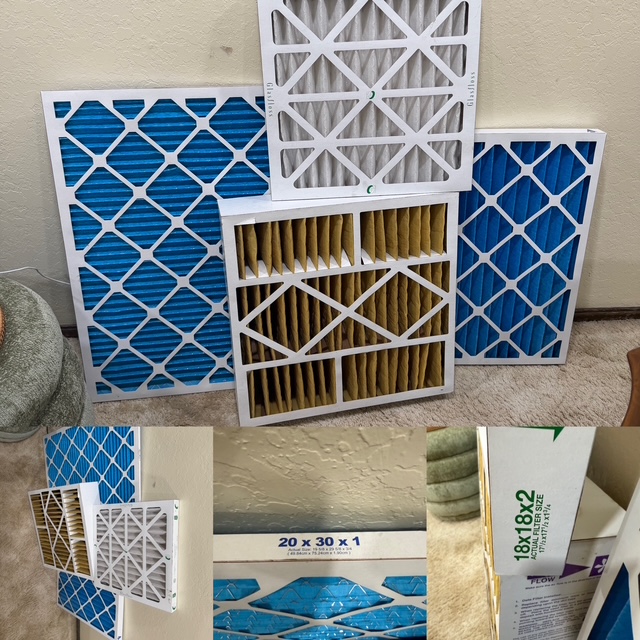
Every HVAC System that moves air should have filters to keep the equipment clean. Without filters, dust accumulates on blower housings, heat exchangers, and evaporator coils causing diminished performance and catastrophic failures such as ruptured evaporator coils and shorted compressors. Filters come in all shapes and sizes, but what size should your filter be? The answer is quite simple if kept simple, but is actually complex. Simply put, a 1″ pleated filter should be sized to be no less than 200 square inches per ton of cooling. So a 3 ton air conditioner should have a minimum of 600 square inches of 1″ pleated filter and a 4 ton air conditioner should have a minimum of 800 square inches of 1″ pleated filter. I see a lot of centrally located return air duct systems. This means the return air vent is centrally located, usually in a hallway, and serves as the primary return of the home. This design is sub standard and a properly designed duct system designed to the ACCA (Air Conditioning Contractors of America) and BPI (Building Performance Institute) Standards would have a return air duct system that is spread out throughout the home just as the supply air vents are. The main reason why centrally located returns are not ideal is due to the fact that they do not meet the minimum requirement of 200 square inches of 1″ pleated filter per ton of cooling required for a properly designed duct system. Simply put, the more return air vents in the home, the more surface area of filter. Every supply air vent in a home is associated with a return air vent. So if only one return air vent is installed, air must travel really far from the outer perimeter supply air vents to return to the unit for conditioning. If these supplies are behind doors that are closable, they may be blocked off totally causing supply air from certain vents to go unconditioned. This also causes rooms with closable doors to be pressurized and the rest of the home to be depressurized causing a slight negative pressure. If your home is under a slight negative pressure, you may experience doors closing on their own when the HVAC unit kicks on and possibly back drafting of flue gasses from natural draft water heaters and cooking fumes in the kitchen. When the home is under a slight negative pressure, air infiltrates through areas of home leakage like wall plates, can lights, bathroom exhaust fans and plumbing penetrations in walls under cabinets and washing machine washer boxes. The only way to resolve the issue of a sub standard duct system installation with a centrally located return air vent and an undersized filter is to conduct an ACCA Manual J and an ACCA Manual D Load calculation (CLICK HERE TO LEARN MORE). At the conclusion of these tests, it will disclose the size unit required to keep the home at 73 degrees on a 9 degree to 100 degree day (For Tulsa Oklahoma Residents) and will define the duct sizing required to evenly distribute the air throughout the home and maintain a Total External Static Pressure on the ducts of .5″ wc or less.
One interesting fact about the filter sizing is if they are sized at the minimum size of 200 square inches per ton of cooling, the filters will need to be changed every 3 months. If the filters are sized at a rate of 800 square inches per ton of cooling, the filters will need to be changed every year and only one time per year. My company, Morris Heat and Air, has designed duct systems to incorporate 5 Seasons Filter Boxes on each of the return air ducts in some homes leading to a ncessary filter change once every 5-6 years. Granted, the filter change for 5ea 2500 square inch filters is nearly $300, but it is only required once every 5-6 years.
If you need help redesigning your ducts and air filtration system to the standards that exist in the HVAC industry, please feel free to reach out to me via email at morrisheatandair@gmail.com. I hope to hear from you and look forward to working with you.